Managerial Achievements
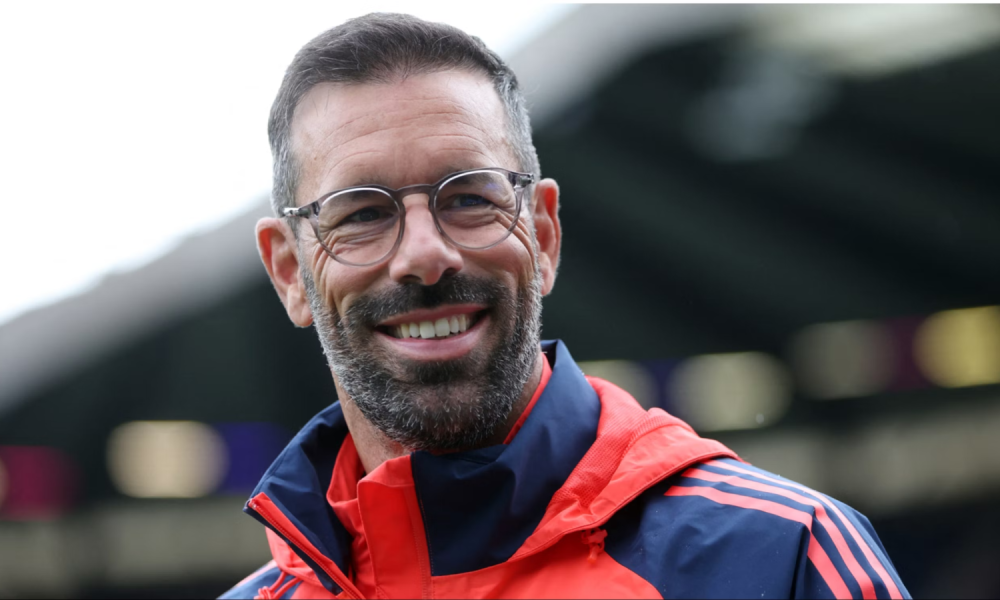
At PSV Eindhoven, Van Nistelrooy delivered significant success in his only season as first-team coach, winning the Johan Cruyff Shield and the KNVB Cup.
Across 50 games, he recorded 34 wins, 8 draws, and 8 losses, while also guiding PSV to the knockout stages of the Europa League.
His ability to manage under pressure and deliver results against top opposition has marked him out as a promising young manager.
CLICK HERE TO JOIN THE CENTRE DEVILS WHATSAPP GROUP CHAT NOW!
With only one season of top flight football to look at, here is how Ruud van Nistelrooy likes to set up a football team.
Build Up Structure
Van Nistelrooy opted for a more rigid buildup structure, often utilizing a 4-2 formation comprised of a back four and a double pivot.
When the ball moved to either touchline, that sided full-back would push high, while another full-back would tuck in, effectively creating a makeshift back three.
Occasionally, a midfielder would drop in beside the back three, aiming to receive the ball and break lines with their passing.
Similarly to the role Toni Kroos played for Germany in the Euros.
However, apart from Christian Eriksen, Manchester United largely lack this type of midfield profile.
While PSV occasionally struggled with width in their attack, this overall setup is far easier to implement than ten Hag’s philosophy, as it is more straightforward and structured.
CLICK HERE TO JOIN THE CENTRE DEVILS WHATSAPP GROUP CHAT NOW!
Off Ball Structure
With Ruud van Nistelrooy joining Manchester United this summer, his off-ball structure has already shown glimpses of effectiveness this season.
While United’s defensive organization has improved, it is still far from perfect.
At PSV, van Nistelrooy employed a 4-2-2 pressing structure, with wingers tucking in to block passing lanes.
This setup bears some resemblance to United’s current structure, but there are two key differences.
Firstly, PSV did not prioritize high pressing; they often dropped into a mid-block, forcing the opposition to take risks while attempting to break the lines.
This allowed PSV to intercept the ball and counter effectively.
In contrast, United try to press but often leaves gaps, making it easier for opponents to play through their press.
Secondly, PSV utilized a man-to-man marking system, with full-backs stepping up to engage the wingers and centre-backs following strikers and attacking midfielders when they dropped deep.
This approach provided greater cohesion within their defensive unit.
If van Nistelrooy were to become Manchester United’s interim manager, it’s likely he would implement a similar strategy.
CLICK HERE TO JOIN THE CENTRE DEVILS WHATSAPP GROUP CHAT NOW!