Though it may seem obvious, United can’t let their biggest weakness get exploited by Arsenal’s biggest strength
Since Ruben Amorim’s appointment, the games have come thick and unforgivably fast.
Ten Manchester United fixtures have been played in the last six weeks as Amorim gets to know more about his team, system, selection and what works.
One of the games United played was against Arsenal on the 4th of December where United for the most part looked assured and controlled the tempo.
Inevitably the game changed when Manchester United conceded too many set-pieces and the Gunners remarkable ability from dead balls won them the game.
United have conceded ten goals from set-pieces in the league this season, Arsenal have scored nine.
It wouldn’t be inaccurate to say that if you can stop Arsenal’s threat aerially, you can stop most of their attacks.
With United’s vulnerability at set-pieces, the FA Cup third round tie against Arsenal could depend on how well the Red Devils defend Arsenal’s corners.
Arsenal be it because of early absentees and injuries have veered to a more pragmatic style of play that has relied on set-pieces for goals.
When Arsenal aren’t looking to score from set-pieces, they opt to get their wingers in space wide to cross and crash the box with multiple players, if a cross doesn’t come in and is blocked by a defender, teams risk conceding a set-piece.

Mikel Arteta has purposefully built a team full of physical, imposing footballers with height and he isn’t afraid to use them both in attack and defence.
Over the first few seasons of the Spaniard’s reign at Arsenal, he worked on increasing the technicality of his players and finding attacking verve.
Over the last couple of seasons and this season particularly, it’s becoming clearer that this Arsenal side relies on their physicality.
The physical profiling of players in their team strengthens this conclusion.
Against Wolves and Newcastle United in tough winter fixtures, the Red Devils were bullied physically and pressed in areas deep in their own half.
Amorim also mentioned how United are a ‘small’ side.
The key for the FA Cup tie will be making sure Manchester United turn up with the same fight as they did vs Liverpool, being strong in the tackle, brave in duels and aggressive in challenges or Arsenal will outmuscle them.
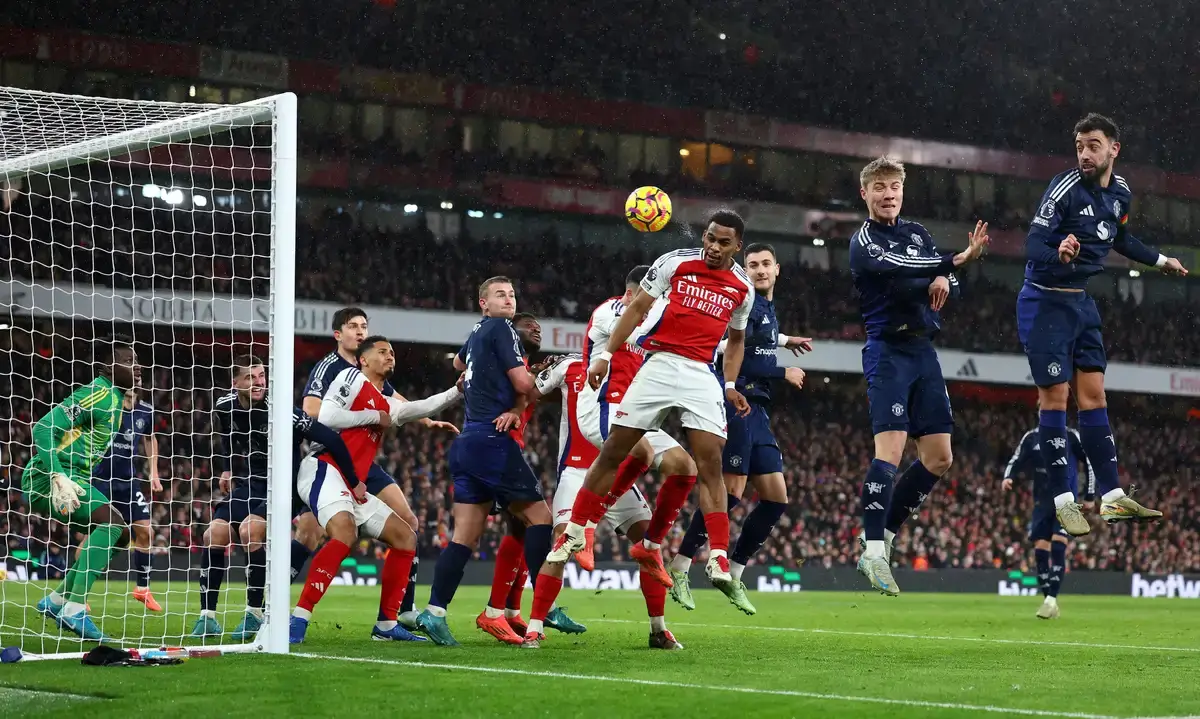
It’s certainly worth taking a look at the corners from the fixture in December to see what United need to do better and what they could change:

The man on the near post is more important than ever as Arsenal’s crosses are whipped into the same zone of uncertainty each time, instead of putting Rasmus Hojlund as the first man to meet the corner, United should put a player on the near post who is better at heading.

As he leaps up to head the ball, the corner goes just over his head and Arsenal head wide.
If one of the centre-backs or someone known for winning headers was on the front post, they’d be more likely to clear the ball.
The problem eventually led to Arsenal’s opener, this time with Bruno Fernandes on the front post.

Once again, Fernandes is not a player who is seen as excellent in the air, or at least a player you would want to meet the corner and clear it emphatically.
Four or five Arsenal players behind the man at the near post always make the same runs into the six-yard area.
Prioritising meeting the ball as a first man lowers the risk of the ball getting into the box where Arsenal players are scattered.
In the last few games since Matheus Cunha scored directly from a corner for Wolves, Andre Onana is actively coming off his line to punch the ball away or gather it.
From the pictures above you can see Onana scramble to claim the ball but not in an assured manner.

It’s always going to be difficult when Arsenal create a melee in the box, but the Cameroonian goalkeeper should parry the ball wide.
There were occasions where Onana parried the ball in the air, leading to Arsenal being able to retrieve the ball and knock it back into the box.
Rasmus Hojlund has already mentioned the importance of dealing with Arsenal’s set-pieces in a pre-match interview.
If Manchester United are going to continue their momentum after a positive performance at Liverpool, they must face Arsenal’s set-pieces with the same defiance as their outing at Anfield.
CLICK HERE TO JOIN THE CENTRE DEVILS WHATSAPP GROUP CHAT NOW!